

When you notice a water stain on your ceiling, you may immediately look for missing shingles. That’s a reasonable place to start, but shingles are only one part of your roofing system, and a leak can develop even when every visible shingle appears to be in place.
Water often gets in around flashing, roof vents, chimneys, skylights, valleys, or drainage areas. It can then travel along the wood beneath your roof before showing up inside your home, which means the stain you see may be far from the actual source.
Knowing what else can cause a roof leak can help you spot trouble sooner and understand what a professional roof inspection should check. It can also help you avoid paying for a repair that doesn’t address the real problem.
1. Damaged or Improperly Installed Roof Flashing
Roof flashing protects some of the most leak-prone parts of your roof. It’s usually made of metal and is installed around chimneys, walls, dormers, vents, and other areas where two surfaces meet.
Its job is to guide water away from joints and openings where moisture could get underneath the roofing materials. If flashing becomes loose, bent, rusted, cracked, or separated from the surrounding materials, water can work its way into the roof even when the shingles nearby still look fine.
A flashing leak may not show up during every rainstorm. You might only notice moisture during heavy rain or when wind pushes water against a chimney, wall, or another roof transition.
Water can also travel along the roof decking or framing before it reaches the ceiling. Because of that, the stain you see indoors may not be directly below the damaged flashing.
Signs that may point to a flashing problem include:
- Stains near a chimney or exterior wall
- Leaks during wind-driven rain
- Visible gaps around metal flashing
- Rusted or lifted metal sections
If the same area keeps getting wet, we recommend having the nearby flashing inspected instead of assuming the closest shingles are the problem. A closer look can often reveal an issue that isn’t visible from the ground.
2. Cracked Roof Vent Boots and Pipe Collars
It’s common for roofs to have vents that pass through them, and the openings around these vents need to be sealed correctly to prevent water from infiltrating your home. Many vent pipes have a rubber or flexible collar around the base, often called a vent boot. Over time, sunlight, heat, cold, and normal aging can cause that material to crack, split, or pull away from the pipe.
Once the seal fails, rain can run down the side of the pipe and into the roofing system. You may notice a ceiling stain near a bathroom, damp insulation in the attic, or moisture around the pipe after a storm.
A vent boot leak is often small, so you may see discoloration without active dripping. It may also take a longer or heavier rain before enough water gets inside for you to notice it.
Useful clues include:
- Moisture near a plumbing vent
- A small attic stain
- Damp insulation below a roof pipe
- A leak that returns after rain
These signs don’t confirm the cause by themselves, but they can help us narrow down where to inspect first. We’ll also look at the surrounding roofing materials to make sure the issue isn’t coming from another nearby component.
3. Chimney Flashing and Masonry Problems
Chimneys are common leak areas because they interrupt the roof surface. Metal flashing around the chimney helps keep water from slipping between the roofing materials and the brick or masonry.
If that flashing becomes damaged or pulls away, water can get inside. However, the roof itself isn’t always the source, so the chimney needs to be checked as a complete system.
Cracked mortar, worn masonry, failed sealant, or damage near the top of the chimney can also let moisture in. From there, water can travel downward until it reaches your attic, ceiling, wall, or fireplace area.
You may notice water stains near the chimney, dampness around the fireplace, crumbling mortar, or moisture that shows up after heavy rain. Because chimney and flashing problems can create similar symptoms inside your home, it’s important to identify the source before making repairs.
Simply adding roofing cement may cover the problem for a short time without fixing what caused it. A proper inspection should look at both the roofing details and the chimney itself.
4. Leaks Around Skylights
Skylights bring natural light into your home, but they also create a large opening in the roof. Keeping that opening watertight depends on the skylight, its flashing, and the nearby roofing materials all working together.
If the flashing is damaged, a seal wears out, or part of the installation fails, water may enter around the skylight. You might notice damp drywall, bubbling paint, discoloration around the frame, or dripping during a storm.
Before assuming the whole skylight needs to be replaced, the surrounding area should be inspected carefully. The leak may be coming from the flashing or roofing materials rather than the skylight itself.
Not Every Moisture Problem Is a Leak
Sometimes the moisture you see is condensation rather than rainwater. Warm indoor air can collect moisture on cold skylight glass, especially in winter.
Timing can help you tell the difference. Moisture that appears mainly during rain may point to a roof leak, while moisture that appears during cold weather without rain may be condensation.
Because the symptoms can look similar, we check both the skylight and the surrounding roof before recommending a repair. That helps us avoid replacing a component that may not actually be causing the problem.
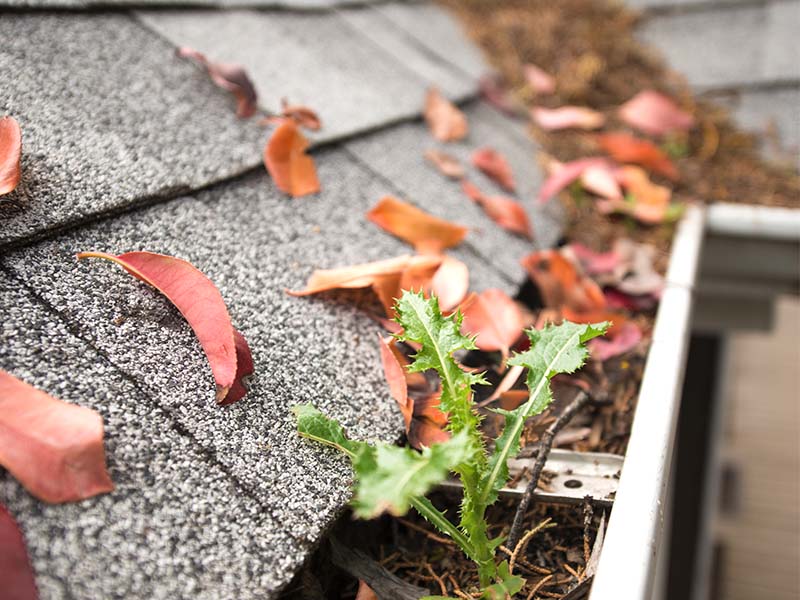
5. Clogged or Poorly Functioning Gutters
Your gutters aren’t part of the roof covering, but they have a major effect on how water moves away from your home. When they can’t drain properly, water may overflow or back up near the edge of the roof.
Leaves, twigs, roofing granules, and other debris can block water flow. Gutters can also sag or sit at the wrong angle, causing water to collect instead of reaching the downspouts.
Over time, that extra moisture can affect the roof edge, exterior trim, and nearby wood. That’s why a leak near the outside edge of your home may sometimes be connected to a gutter problem rather than the shingles themselves.
You can often spot gutter problems from the ground while it’s raining. Pay attention to how water moves through the system and whether it’s draining away from the home as expected.
Look for:
- Water spilling over the gutter
- Water running behind the gutter
- Sagging sections
- Weak downspout flow
- Water collecting near the house
Since poor drainage can allow water to collect in places where your home is more vulnerable, it’s important your gutter system receives attention alongside your roof.
6. Problems in Roof Valleys
A roof valley is the area where two roof slopes meet. Because water from both sides runs through this channel, valleys handle a large amount of runoff during heavy rain.
These areas need to be installed carefully. Depending on your roof, the valley may use shingles, underlayment, metal flashing, or a combination of materials.
If any of those materials become damaged or shift out of place, water can get underneath the roof covering. Leaves and other debris can also collect in the valley and slow drainage, which may increase the chance of water reaching a weak spot.
You shouldn’t climb onto a steep or wet roof to inspect a valley, but some warning signs may be visible from the ground. Look for leaves or branches collecting in the valley, lifted shingles, obvious wear, or dark areas that stay damp longer than the surrounding roof.
Because so much water passes through a roof valley, a small problem can become more serious over time. If you keep seeing moisture below a roof intersection, it’s worth having that area inspected before the damage spreads.
7. Exposed or Backed-Out Roofing Nails
An exposed or loose roofing nail can sometimes be enough to let water beneath the roofing materials. This can happen even when the surrounding shingles still look normal from the ground.
Roofing nails are supposed to be covered and positioned correctly. If one is placed in the wrong spot, left exposed, or gradually works its way upward, rainwater can follow the fastener into the roof.
These leaks can be frustrating because they’re often slow and inconsistent. You may notice a stain gradually grow after several storms instead of seeing obvious dripping every time it rains.
Covering an exposed nail with sealant may stop the water temporarily, but the nearby roofing materials still need to be checked. The nail may have moved because of an installation issue, aging materials, or movement in the roof.
When we inspect a suspected fastener leak, we look at the area around the nail as well as the nail itself. That helps us determine whether moisture has affected anything underneath and whether a more complete repair is needed.
8. Failed Sealant Around Roof Penetrations
Roof sealants can help protect certain joints and openings, but they don’t last forever. Sun, rain, heat, cold, and movement in the roofing materials can cause them to crack, shrink, or pull away over time.
Once a seal opens up, even a small gap can let water into the roof. These problems are especially common around penetrations and transitions where different materials meet.
Common trouble spots include:
- Plumbing vents
- Flashing joints
- Roof-mounted equipment
- Exposed fasteners
- Metal roof transitions
Adding more caulk over old, failing sealant may hide the opening without correcting the reason it failed. A lasting repair should address both the gap and the condition of the surrounding roofing materials.
9. Wall and Roof Intersections
Where a sloped roof meets an exterior wall, several parts of your home have to work together to keep water out. Roofers often use step flashing in these areas to guide water away from the wall and back onto the roof.
If that flashing is missing, damaged, or poorly connected to the siding, water can slip behind the exterior materials. You may then notice a stain on an interior wall, peeling paint, or moisture near the roofline instead of a leak in the middle of the ceiling.
A roof-to-wall leak may involve more than one part of your exterior. The flashing, siding, moisture barrier behind the siding, and nearby drainage all need to work together.
That’s why replacing a few shingles won’t necessarily solve this type of leak. We want to identify which part of the wall and roof connection is allowing water in before recommending a repair.
10. Ice Dams and Winter Water Backup
Winter leaks can happen even when the roof surface looks fine. Ice dams are one possible cause during periods of snow, melting, and refreezing.
Ice dams form when snow melts higher on the roof and freezes again near the colder roof edge. As the ice builds up, more meltwater can collect behind it instead of draining into the gutters.
That trapped water may work underneath the roofing materials and enter your home. You could notice damp insulation, stains near an outside wall, or ceiling damage after repeated freezing and thawing.
Ice Dams Can Point to Attic Problems
The ice may be only part of the issue. Heat escaping from your home into the attic can affect how snow melts on the roof and may contribute to uneven melting.
Poor insulation, air leaks, and ventilation problems can all influence attic temperatures. If ice dams keep returning, it’s worth looking beyond the ice itself and checking the conditions that may be contributing to it.
You shouldn’t try to break ice off the roof with a shovel or sharp tool. That can damage shingles, flashing, and gutters, and it may create another leak in the process.
11. Attic Condensation That Looks Like a Roof Leak
Not every water stain comes from rain entering through the roof. Sometimes moisture forms inside the attic instead, especially during cold weather.
Warm, humid air from your home can rise into a cold attic and turn into condensation on the underside of the roof or on metal nails. That moisture can drip onto insulation and ceilings, making it look like the roof is leaking.
Bathroom fans that vent into the attic, high indoor humidity, air leaks, or poor attic airflow can all contribute to the problem. That’s why it’s important to consider what’s happening inside the attic as well as what’s happening on the roof.
Timing Can Help You Tell the Difference
If you notice moisture even when it hasn’t rained, condensation may be part of the problem. Frost on roofing nails, damp wood in several attic areas, or wet insulation during cold weather can also point in that direction.
You still shouldn’t assume the cause based on one symptom. We can look at both the attic and roof to determine whether water is coming in from outside or forming inside your home.
12. Aging Underlayment Beneath Intact Shingles
The shingles you see are only the top layer of your roof. Beneath them is another protective layer called underlayment, which helps provide added protection if moisture gets past the shingles.
As a roof ages, that hidden layer can wear down too. Problems may become more noticeable near roof openings, previous repairs, valleys, or other areas that are exposed to more water.
That means your shingles may still look fairly normal while the materials underneath are no longer doing their job as well as they should. Hidden wear is one reason a roof can leak even when you don’t see obvious damage from the ground.
A quick visual check can help you spot missing or damaged shingles, but it can’t show you what’s happening underneath them. If you have an older roof, repeated leaks, several past repairs, or moisture with no obvious exterior damage, a professional inspection can provide a much clearer picture of the roof’s condition.
13. Previous Roof Repairs That Didn’t Address the Source
If you’ve had a leak repaired before and the water keeps coming back, the earlier repair may not have addressed the true source. In some cases, the repair may have covered the visible problem without stopping the water from entering elsewhere.
Old roofing cement can crack, flashing can continue leaking, and layers of sealant can make the original issue harder to see. You may also have more than one leak in the same general area.
Recurring Leaks Need Extra Attention
When a leak returns, it’s important to look beyond the previous repair. The original patch may not be the only area that needs attention, especially if water is traveling before it becomes visible indoors.
Depending on the symptoms, we may need to inspect roof vents, flashing, nearby gutters, attic conditions, and the wood beneath the roof. Following the path of the water helps us find where it’s actually getting in instead of repeatedly treating the same stain.
What to Do When You Discover a Roof Leak
When you notice a roof leak, your first step should be protecting the inside of your home. Move furniture and belongings away from the wet area, protect the floor if possible, and take photos of any visible staining or dripping.
A few simple details can also help us understand what may be happening. The more you can tell us about when and where the moisture appears, the easier it may be to narrow down the source.
Make note of:
- Where the moisture appears
- When you first noticed it
- Whether it happens during every storm
- Whether wind makes it worse
- Whether the area has been repaired before
You shouldn’t climb onto a wet, icy, steep, or damaged roof to look for the source yourself. Besides the risk of falling, walking on damaged roofing materials can make the problem worse.
It’s also important to remember that the stain inside your home may not be directly below the leak. Water can travel along wood, pipes, or insulation before it becomes visible, so we look at the surrounding roof area rather than focusing only on the stain.
Does a Roof Leak Mean You Need a New Roof?
A leak doesn’t automatically mean you need a full roof replacement. If the problem is limited to a vent boot, flashing detail, exposed nail, or another small area, a targeted repair may be enough.
The overall condition of your roof still matters. Its age, repair history, amount of wear, and the number of problem areas can all affect whether repair or replacement makes more sense.
When Roof Repair May Be Appropriate
A repair may be the better choice when the rest of your roof is still in good condition. In that situation, fixing the specific problem can restore protection without replacing roofing materials that are still performing properly.
Examples may include one failed vent boot, localized flashing damage, an exposed fastener, or a small leak around a roof opening. The important part is making sure the problem is truly limited to one area.
A small ceiling stain doesn’t always mean the issue above it is equally small. That’s why we still check the surrounding roof before recommending a repair.
When Roof Replacement May Make More Sense
Replacement may be worth considering when leaks are part of a larger pattern. If several areas are failing or you’ve already had numerous repairs, continuing to fix one problem at a time may not be the most practical long-term approach.
Widespread wear, multiple recurring leaks, and problems across several parts of the roof can all influence that decision. The goal is to choose the option that makes sense for the condition of your roof rather than assuming every leak needs the same solution.
EC Roofing provides roof inspections, roof repairs, and complete roof replacements. Our team can evaluate your roofing system, explain what we find, and help you understand the options for your home.
Stop a Roof Leak Before It Causes More Damage
Missing shingles are only one possible cause of a roof leak. Damaged flashing, worn vent boots, chimney problems, skylights, valleys, gutter issues, failed sealant, aging materials beneath the shingles, and attic condensation can all lead to moisture inside your home.
Finding the true source matters because repairing the wrong area can allow the leak to continue. The sooner you have recurring or unexplained moisture checked, the sooner you can protect your ceilings, walls, insulation, and other parts of your home from additional damage.
If you’re dealing with a roof leak in Maryland or South Central Pennsylvania, contact EC Roofing. Our team can inspect your roof, identify the source of the problem, and recommend the right repair or replacement solution for your home.